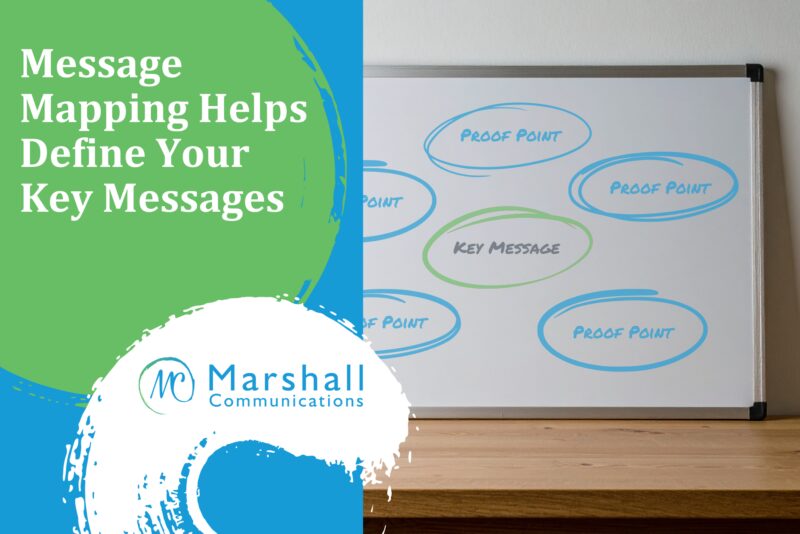
A message map is a tool we use with many of our clients at Marshall Communications as the foundation for all public relations and marketing programs as well as part of The Marshall Plan® process. It includes a key message at its center that is 21 words in length. It takes seven seconds to say 21 words out loud. If you are familiar with broadcast news, you know that reporters and editors love seven-second sound bites.
This key message isn’t just for media interviews. It’s used across brochure copy, speaking engagements, website content and newsletters. You can use it everywhere you are talking about the organization. It’s like a song sheet that allows everyone to sing in harmony. You know the phrase, “Let’s all sing from the same song sheet?” Your message map allows you to do just that.
Structuring Your Key Message: The “XYZ” Statement
The key message needs to focus on “concern for the customer,” or in the case of a nonprofit, it could be about concern for the people that the organization serves.
One way to structure your key message at the core of your message map is to use an “XYZ” statement. Fill in the blanks: “We do X, for Y, so they can Z.”
Here’s an example of an XYZ statement:
At Marshall Communications, we create strategic marketing communications plans for clients statewide and nationally so they can grow significantly.
It’s best to think of how you are a “strategic hero” ready to swoop in and save the day for your clients or customers. Think about what keeps them up at night, and how you can help bring them peace of mind in whatever concerns them the most.
Supporting Messages and Proof Points
A message map also includes proof points or supporting messages that can be used in conjunction with the key message in order to tell the story of your organization or company, or even a specific crisis situation. For Marshall Communications, our proof points are:
- Our experience
- Our client list
- Methodology: specifically, The Marshall Plan® process
- Client success stories
- Our team
- Targeted industries: tourism/economic development; education/nonprofits; medical/healthcare
The Origins of Message Mapping
I learned about message mapping from Tripp Frohlichstein who has a company called Media Masters Training. Tripp is an expert in the field of crisis communications. He helps spokespersons for organizations that have been through a crisis to refine their message before they are interviewed by the media.
At Marshall Communications, we’ve adapted Tripp’s message mapping techniques so they aren’t always related to a crisis. We use them to help companies and nonprofits explain who they are in a concise way. You need to be ready when The Today Show calls and invites you to tell the story of your organization on the show.