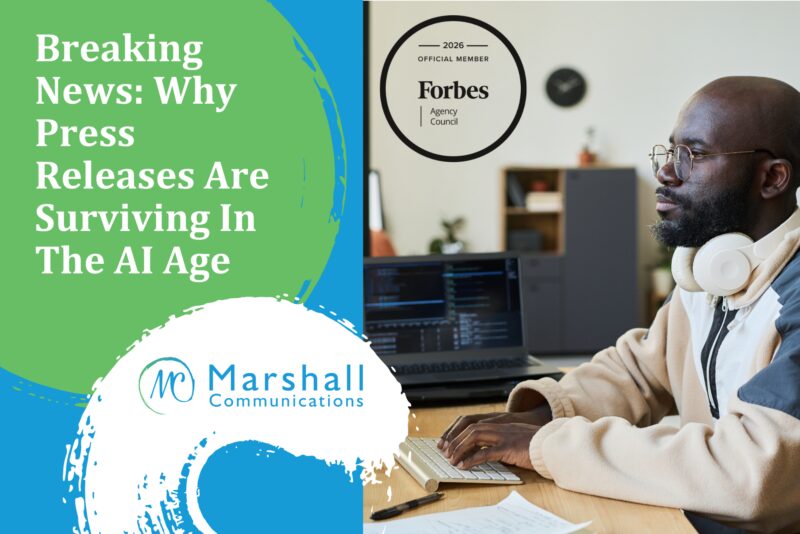
Breaking News: Why Press Releases Are Surviving In The AI Age

Public relations isn’t dead. Discover how press releases still shape journalism and even AI tools in today’s evolving media landscape.

For years, we have heard that public relations is outdated. Does PR still work? Aren’t people sick of PR practitioners? Aren’t they tired of the “middleman” (or woman)? These questions have been swirling for a while, and the press release is a case in point. Aren’t press releases “dead”? Aren’t journalists sick and tired of press release content?

The Evolution of PR in a Changing Media Landscape

In reality, the PR industry has consistently adapted and evolved since the first press release was issued by Ivy Lee about a railroad accident in 1906. Over the decades, we have navigated the emergence of the internet and social media and other signs of the changing times to remain relevant. And yes, PR professionals remain relevant, too.

I am obviously biased, but journalists still need press releases and other forms of media outreach for informational purposes. Reporters, editors and other media contacts want to learn more about notable people, companies and industries, and PR experts—through timely, valuable pieces of content—provide that information for journalists who can then use it for their reporting. The need for solid information has not gone away; if anything, in a society where misinformation and disinformation are more common than ever, this sort of information matters more than ever.

We need the facts! And it’s up to journalists to report the facts, often based on PR experts who know what is newsworthy and when. You know who else needs the news? Artificial intelligence.

How AI Is Changing the Value of Press Releases

AI tools such as ChatGPT and Google Gemini rely on news stories and other media hits to source their responses to user queries. As AI-generated queries become more and more popular, people are relying on responses that come from somewhere, and that “somewhere” may be traditional reporting. In many cases, users are coming across AI answers that are essentially repurposed from journalistic content. And where does that content originate? Often from press releases and other forms of media outreach. In fact, it is very possible for content to go from a press release to a news story and then to an AI answer based on a specific question.

In other words, large language models (LLMs) are reading the news to train and spit out information. LLMs don’t just make up information (except when they “hallucinate”); they depend on reputable websites and platforms to find it, contextualize and summarize it, and then share it with users. This might be a news story or even a newswire release, which isn’t “reported” in the traditional sense, but still introduces AI to a newsworthy announcement.

In many ways, the press release is perfect for the LLM. Press releases—at least the best ones—tend to be structured and highly factual with clear, concise statements. There may be certain spin involved, but press releases are easy to grasp for a reason. They are supposed to focus on the big picture without getting bogged down by tiny details, and AI therefore finds this information easy to reference.

Note: Not all LLMs are the same. As Michael Mahin, Ph.D., points out, ChatGPT doesn’t browse the live web, whereas some others—Google Gemini being one of them—do pull in real-time content. This still translates to hundreds of millions of users—people who may encounter press release content.

A Call to Action for Modern PR Professionals

I look at the changing times as a call to action for PR experts everywhere. Now is the time for us to double down on valuable, newsworthy content that might be used by a reporter or an editor or eventually an LLM like Gemini. Knowing that press releases have taken on newfound significance because of AI, it’s up to us to create good content. This means drafting headers and subheaders that are easy for journalists (or AI) to digest and could become news headlines in their own right. It also means keeping body paragraphs short and sweet, articulating the “what,” the “where” and the “when” clearly in the case of events and other time-sensitive announcements, plus “why” they are important to announce in the first place. And don’t forget a picture for extra color!

Once again, we are seeing PR adapt and evolve with new-age technologies. Based on firsthand experience, I have seen client work—from website blogs and social media posts to news stories—pop up in LLM searches, and it is exciting to see. Just like securing a front-page story in a top newspaper is exciting, we should be encouraged that our content might find its way to an AI response that reaches millions of people.

If you work in PR, focus on becoming the best possible version of your content creator self. If you do that, public relations as an industry will remain alive and well, and so will the press release. Our bread and butter is still fresh.


This article originally appeared on the Forbes Agency Council CommunityVoice in October 2025.


FAQs

Is public relations still relevant in today’s media landscape?
Yes. PR has continually adapted since the first press release in 1906, evolving alongside the internet, social media, and other technologies. Journalists and media outlets still rely on PR professionals for timely, accurate, and newsworthy information.

Are press releases “dead”?
No. Press releases remain an essential tool for sharing structured, factual information. They help journalists, editors, and even AI systems access accurate news, making them more important than ever in a world with widespread misinformation.

How does AI affect the value of press releases?
AI tools like ChatGPT and Google Gemini often source responses from news stories and media content, including press releases. Well-crafted press releases can therefore reach millions indirectly through AI-generated answers, giving PR content a new kind of visibility.

What makes a press release effective in the age of AI?
A strong press release is clear, concise, and structured. Use headers and subheaders that summarize the news, keep body paragraphs short, and include the “what, where, when, and why.” Adding visuals can enhance engagement and help both journalists and AI understand the story quickly.

How can PR professionals stay relevant in a changing media environment?
PR experts should focus on creating valuable, newsworthy content. By honing skills as content creators, producing precise and well-structured releases, and adapting to new technologies like AI, PR professionals can ensure their work remains influential and widely disseminated.

The Marshall Plan®
Marshall Communications can help grow your brand.
icon for strategy

Learn how our customized, collaborative, comprehensive & strategic marketing, branding & communications plan, The Marshall Plan®, is developed to help you achieve measurable results.

Learn more about The Marshall Plan®

The Marshall Report
Subscribe to receive our monthly Marshall Report, full of helpful information and tips on public relations, marketing, social media, personal branding and more.
icon for email sign up
The PR Maven® Podcast
Weekly podcast with industry leaders, top executives, media personalities and online influencers.

The PR Maven® Podcast is about using a combination of traditional networking techniques and the power of social media to help you build your personal and professional brand. Listen to the podcast

Listen to Podcast